It's refinement day. The backlog has 600 tickets. One from two years ago, titled "improve performance" — no description, no owner. Three separate tickets about the same login issue, added months apart by different people. A dozen marked "high priority" that haven't moved in a quarter. Nobody knows what half of it means anymore.
Sounds familiar? Let's fix that.
What is a "clean" backlog?
A clean backlog isn't just a short one. It's a useful one — a tool your team actually trusts and engages with.
- Small enough to understand. If you can't roughly summarize what's in there, it's too big.
- Free of duplicates and zombies. No overlapping ideas. No tickets quietly rotting since last year.
- Purposeful. Every item has a clear reason to exist — a problem it solves, a value it delivers.
- Prioritized meaningfully. Not everything tagged "high." Actual relative ordering that reflects real decisions.
- Partially ready. The top slice is always refined and ready to pull. Not everything needs full detail, but near-term work does.
- Understood by the team — not just the PO. If only one person knows what's inside, that's a bottleneck and a single point of failure.
What makes a backlog "dirty"
Dirty backlogs don't happen overnight. They decay slowly, through a handful of habits that feel harmless in the moment.
"We might need this someday."
The most common way backlogs die. Every preserved ticket that nobody cares about costs mental overhead every time someone scrolls past it. You're paying a tax on indecision — and that tax compounds.
Duplicate and overlapping ideas
Usually a sign the backlog isn't a shared tool — it's a dumping ground. The left hand doesn't know what the right hand wrote three months ago.
No real prioritization
When everything is important, nothing is. Teams that can't say "this matters more than that" are making implicit decisions through inaction — which is the worst kind.
Vague tickets with no acceptance criteria
"Improve dashboard" is not a ticket. It's a wish. Vague tickets create vague conversations that waste everyone's time in refinement.
Only touched at painful refinement meetings
If the backlog is only opened every two weeks in a meeting nobody enjoys, of course it decays. You're applying medicine to a wound once a fortnight and wondering why it's infected.
The core idea: cleanliness is a habit, not a task
Here's what most teams get wrong. They treat backlog cleanup as an event.
"Let's schedule a grooming session." "We'll do a big cleanup next quarter."
It doesn't work. You do the big cleanup, feel great for two weeks, and then entropy wins. The backlog decays right back to where it was — sometimes faster, because the team thinks "we just cleaned it."
Backlogs decay naturally. That's not a process failure — it's just how information ages.
New context emerges. Old ideas lose relevance. Priorities shift. The backlog that was accurate in January is already partially wrong by March. The only answer is continuous, lightweight care. Not surgery once a quarter — daily hygiene.
Habits that actually keep a backlog clean
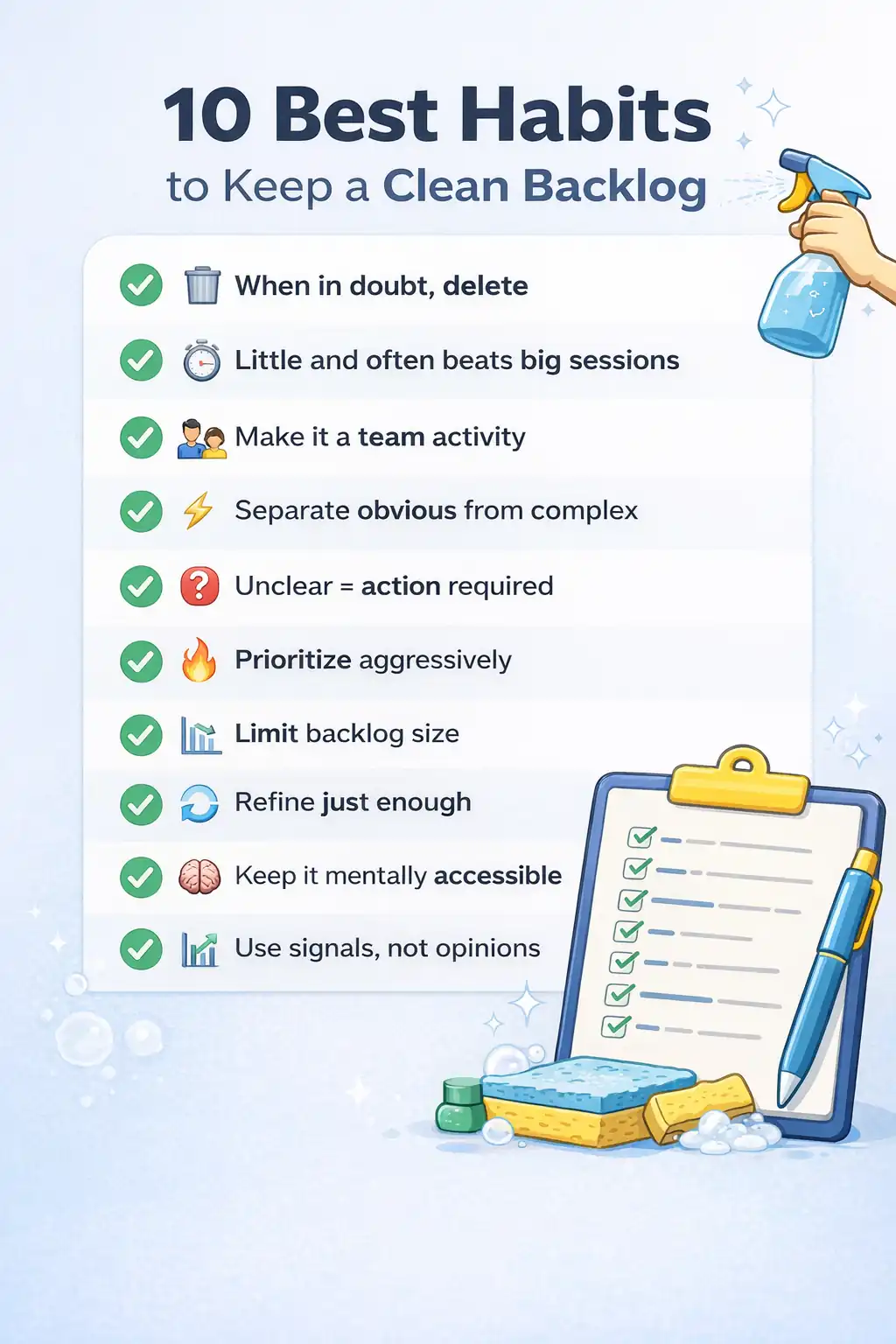
When in doubt, delete
This is the most important mindset shift. The default in most teams is preservation — "let's keep it, just in case." Flip that default. The question shouldn't be "should we remove this?" It should be "why are we keeping this?" Old tickets lose relevance fast. If nobody has mentioned it in three months, it's already dead — it just hasn't been buried. Delete it. Important things have a way of resurfacing. Trust that.
Little and often beats big sessions
Five minutes of triage at the end of a planning meeting is worth more than two hours of quarterly cleanup. The context is fresh, the decisions are faster, and it doesn't feel like a chore. Small, frequent touches compound. Big, rare events regress.
Make it a team activity
Backlog ownership shouldn't live in one person's head. When engineers, designers, and testers all have context and input, the quality of backlog decisions improves dramatically. More perspectives catch duplicates. Shared understanding means planning conversations take minutes, not hours. The PO still makes final calls — but the team helps carry the knowledge.
Separate the obvious from the complex
Not every backlog decision requires a conversation. Most tickets are obviously dead, obviously valuable, or obviously ready. Train yourself and your team to move quickly through these — save your limited refinement time for the genuinely hard, ambiguous ones. "What can we drop without discussion?" Usually there's more in that pile than expected.
Prioritize aggressively
A backlog is not a storage system. It's a decision system. If two items feel equally important, ask which one you'd do first if you could only pick one. That's your answer. A backlog where everything is equally important communicates nothing.
Limit backlog size intentionally
Some teams set a rule: adding a new ticket means something else gets removed or merged. This constraint sounds harsh — it isn't. It forces honesty about what actually matters and creates healthy tension around every addition. If your backlog can't fit in your head, it's too big.
Refine just enough
Not every ticket needs full acceptance criteria and a story point before it enters the backlog. Future ideas can stay lightweight — a title and a few lines of context. Focus refinement energy on near-term work. Over-specifying tickets too early is a waste: requirements change, context evolves. Keep future work lean until it's close enough to matter.
Keep it mentally accessible
Your team should roughly know what's in the backlog without opening it. If someone says "I have no idea what's in there" — that's not a minor issue, it's a signal. When the backlog is a black box, trust in the process drops. Regular, lightweight exposure keeps context fresh and the team engaged.
Why async habits work better than meetings
The teams with the healthiest backlogs aren't doing more refinement meetings — they're doing less. They've built async habits instead: a quick check before adding a ticket, a lightweight team vote on priorities, a shared channel where additions are visible without requiring a meeting.
Async backlog hygiene fits into natural workflow. It doesn't require scheduling, doesn't create meeting fatigue, and encourages independent thinking before everyone crowds into a room. It creates continuous alignment instead of periodic, high-stakes sync moments.
When teams rely exclusively on refinement meetings for backlog decisions, they compress all that cognitive load into a two-hour slot every two weeks. That's why those meetings are exhausting. Spread the load. Make it continuous.
A clean backlog is a competitive advantage
Teams with clean backlogs move faster. Planning sessions take thirty minutes, not two hours. Everyone knows what's coming. Decisions are made earlier, when they're cheaper. Sprints start with momentum instead of confusion.
The teams that have internalized this don't talk about backlog cleanup as a chore anymore. It's just how they work. Lightweight. Continuous. Almost invisible. Not a perfect backlog — backlogs are never perfect. But a living one, that reflects current reality and earns the team's trust.
Keep it practical. Be aggressive about deleting. Make it a team sport.
The mess is optional.